The 1924 Everest Expedition

In 1924, a British team attempted to conquer Everest from the north side. Marked by boldness, records, and tragedy, this expedition remains one of the most iconic in mountaineering history.

Everest 1924 Expedition
An assault via the north face
The 1924 expedition chose the Tibetan approach. Under the leadership of General Bruce, and later Edward Norton after his illness, the climbers established a chain of high camps along the northeast ridge. From there, the decisive summit attempt would begin.

8,573

In meters, the world altitude record reached without oxygen

8,848

In meters, the official height of Everest

6

6 weeks, duration of the expedition on the mountain

2

Missing climbers, Mallory & Irvine

The pioneers
1924 Mount Everest Expedition

The expedition begins under Brigadier Charles G. Bruce; falling ill along the way, he transfers command to Norton, who will reach 8,573 m without oxygen. The team includes George Mallory, Andrew “Sandy” Irvine, Howard Somervell, Noel Odell, Geoffrey Bruce, Bentley Beetham and John de Vars Hazard, supported by dozens of Tibetan and Sherpa porters.

A record of altitude
Norton

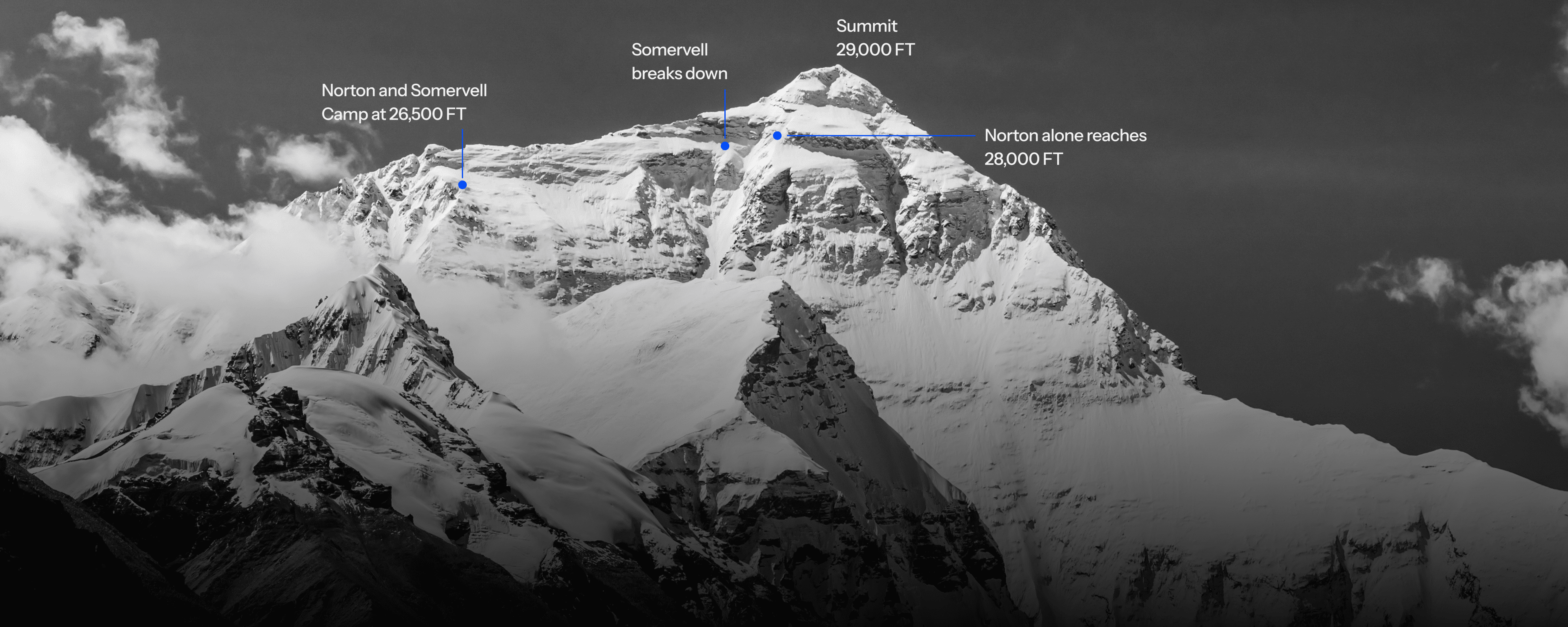
On 4 June, Norton climbs without oxygen through the Yellow Bands and reaches 8,573 m, a height never reached before. His bold route opens what will become the “Norton Couloir”. This record will remain unbeaten for nearly thirty years.

Mallory & Irvine, the enigma
Andrew Irvine, George Mallory

Four days later, George Mallory and Andrew Irvine vanish above 8,000 metres. Did they reach the summit before they died? Their tragic fate continues to fuel one of Everest’s greatest mysteries.

The Norton Couloir
Norton Couloir Everest

In 1924, Norton opened a new diagonal passage through the Yellow Band, above 8,400 m. This direct line, later named the “Norton Couloir”, remains a known alternative to the Northeast Ridge route. Exposed to wind and rockfall, it stands as a symbol of Norton’s boldness in the “death zone”.

Edward Norton, the quiet strength of Everest

British officer and discreet mountaineer Edward Felix Norton embodies a rare kind of courage: calm and mastery. In 1924, he reached 8,573 meters without oxygen, opening the “Norton Couloir” and leaving a lasting mark on mountaineering history.

Starting point of the expedition
Norton left London for British India, trained in Darjeeling, and then traveled toward Everest’s base camps. From the North Base Camp, the route via the Yellow Band and the Norton Couloir emerged as a bold alternative to the classic Northeast Ridge.
About the expedition